FIND JOBS IN AI GUIDE
AI assessment guide: evaluate answers with evidence
AI work assessments vary by project. Some ask you to compare answers, check facts, label data or explain a specialist decision. This practice guide shows a general answer-evaluation method, using a fictional example you can work through yourself. Always follow the actual assessment instructions, including any rules about outside tools.
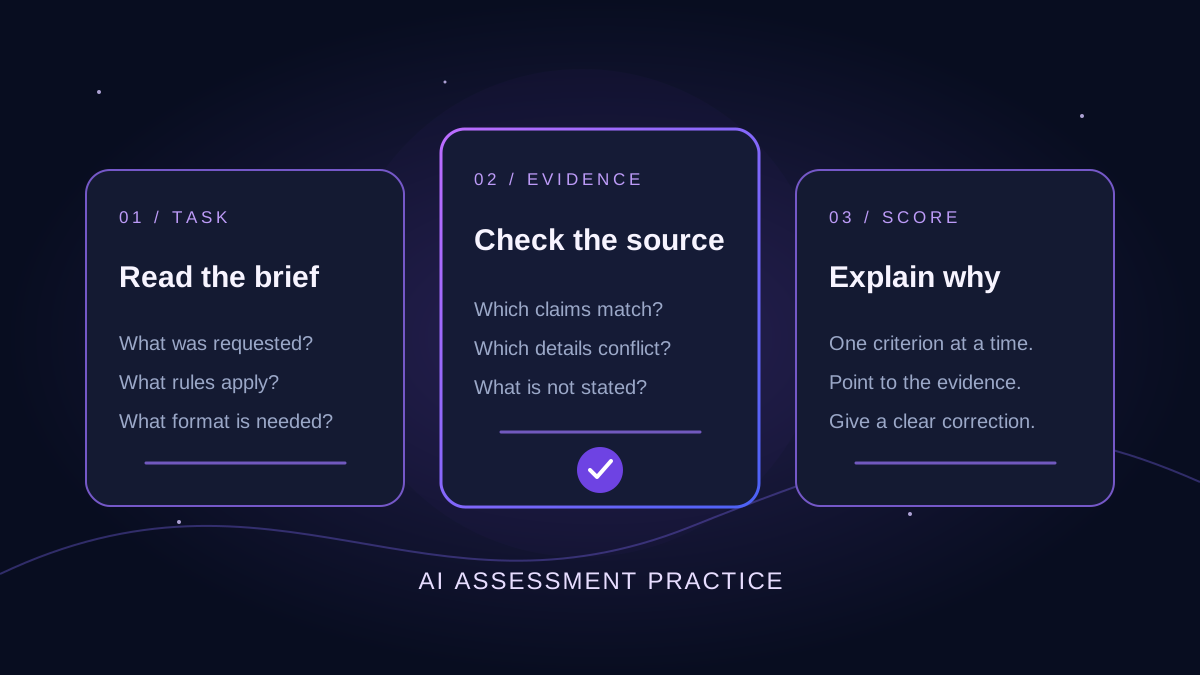
Read the task before judging the answer
Underline the exact request, supplied reference material, output format and any restrictions. A polished answer can still fail by missing one explicit instruction. Separate requirements that can be checked from preferences such as tone.
Check what evidence you are allowed to use. If a task says to rely only on a provided document, do not fill gaps from memory or an outside search. If it permits research, record the source and check that it actually supports the claim.
A practice task you can score
Fictional prompt: “Using only the notice below, tell customers the workshop date, start time and whether they need to bring a laptop. Answer in one sentence.” Notice: “The workshop is on Thursday 15 October. Doors open at 09:30 and the session begins at 10:00. Laptops are provided.”
Candidate answer: “The workshop is on Thursday 15 October at 09:30, and you should bring your own laptop.” Before reading on, decide which parts are supported, which are wrong and what you would write back to the contributor.
Score one observable point at a time
A useful rubric for this example checks four separate points: the date is Thursday 15 October; the session starts at 10:00; laptops are provided, so customers need not bring one; and the response is one sentence. The candidate answer passes the date and one-sentence checks but fails the start-time and laptop checks.
09:30 is the door-opening time, not the start time. The notice does not ask customers to bring a laptop; it says laptops are provided. Scoring these as separate errors avoids hiding two mistakes inside a single “accuracy” label.
Write feedback another person can act on
A useful review names the claim, points to the evidence and explains the correction: “The response gives 09:30 as the workshop start, but the notice says doors open then and the session begins at 10:00. It also says to bring a laptop, while the notice says laptops are provided.”
“Incorrect” alone does not show what to fix. A long rewrite is not always needed either: follow the task’s requested format, and keep the judgment tied to the supplied evidence.
Handle uncertainty without guessing
If the source did not mention laptops, the defensible judgment would be “not stated”, not “bring one” or “none needed”. When two sources conflict, flag the conflict and apply the project’s precedence rule if one is given.
For specialist tasks, distinguish what you can verify from what requires a qualified reviewer. A fluent explanation is not proof that a medical, legal or financial claim is correct.
Prepare for the real assessment
Read the hiring organisation’s instructions on time limits, tool use, confidentiality, payment and attempts. Practise producing a short evidence-based explanation before focusing on speed. Review your work once for missed constraints, unsupported claims and accidental contradictions.
This exercise is practice, not a promise of what any particular employer will ask or how it will score you. Never submit private project material to an outside tool unless the project explicitly permits it.
Worked score: two correct, two to fix
For the fictional workshop task, mark date ✓ (Thursday 15 October), start time ✕ (the session starts at 10:00, not 09:30), laptop guidance ✕ (laptops are provided), and one-sentence format ✓. A corrected answer is: “The workshop is on Thursday 15 October at 10:00, and you do not need to bring a laptop because one will be provided.”
A five-minute practice routine
Take a short, publicly available notice that contains a date, a condition and a clear exception. Write a one-sentence answer to a precise question, then invent two plausible errors. Score each error against a separate criterion and explain the correction in one or two sentences.
The aim is to practise careful reading and traceable feedback. Do not memorise a template so rigidly that you ignore a real project’s instructions.
When comparing two answers
Check each answer against the same requirements before choosing a winner. One response may be more fluent but contain an unsupported claim; another may be terse but fully correct. State the deciding criteria and the evidence, rather than relying on style alone.
If both answers fail, say so when the task allows it. Do not force a positive judgment that the rubric does not support.
Questions to ask before you start
- What exact output and evidence does the task require?
- Am I confusing a nearby detail, such as opening time, with the answer requested?
- Can each scoring criterion be judged independently?
- Does my feedback identify the specific claim and supporting source?
- What do the assessment rules permit me to research, quote or use as a tool?