FIND JOBS IN AI GUIDE
AI-work CV examples and application checklist
A useful AI-work application shows evidence that matches the actual tasks. You do not need to rename your previous job or claim AI experience you have not earned. Use these fictional examples as a structure, replace every detail with your own truthful evidence and follow the vacancy’s mandatory requirements.
By Find Jobs in AI · Updated
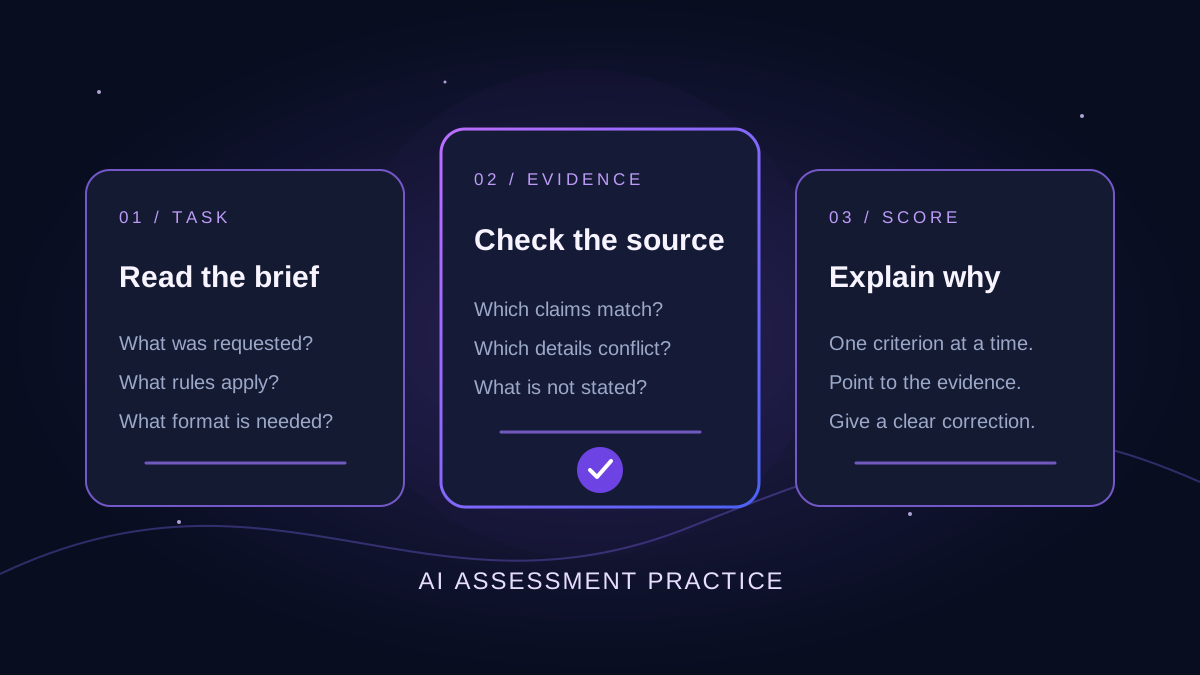
Start with a requirement-to-evidence check
Read the full vacancy and separate mandatory requirements from preferences. Write each requirement beside evidence you actually have: the relevant job, qualification, tool or work sample. If a licence, country requirement or named qualification is mandatory, transferable skills do not replace it.
For example, a generalist image-labelling role might value following detailed guidelines, visual accuracy and clear explanations. A physician review role may additionally require current registration, board certification and recent clinical practice. Treat those as different applications.
Worked example: show transferable experience
Fictional starting point: a customer-operations assistant checked order records against a written procedure and escalated ambiguous cases. A vague CV line such as “Excellent attention to detail” does not show how that skill was used.
A more useful example is: “Checked order records against the team’s written classification rules, recorded discrepancies and escalated cases the procedure did not resolve.” Add a real, supportable volume or outcome only if you have one. This example does not establish professional AI-training or image-annotation experience.
For a real application, identify your own equivalent task, the rule or standard you followed, what you produced and how quality was checked. Do not copy the fictional job history.
Worked example: label personal practice accurately
If you completed a fictional annotation exercise, place it under “Independent practice”, with the date and a short description such as: “Applied a three-label text-classification rubric to fictional messages and compared decisions against the worked explanations.”
Do not list this as paid project experience, a client engagement or a certification. A public practice task cannot substitute for a project’s assessment or mandatory experience. Follow any restrictions on outside tools during the actual selection process.
Worked example: a specialist application
For a healthcare role, a summary template could read: “[Profession] with [verified qualification/registration] and experience in [actual setting]. My work includes [relevant review or documentation task] using [applicable standard].” Replace the placeholders only with facts you can support.
Include required registration jurisdiction and status where appropriate, relevant specialty experience and recent practice dates. Describe methods without sharing patient records, confidential project files or employer-owned assessment material. Similar principles apply to legal, finance, engineering and research credentials.
Use a short, role-specific application note
A useful structure is: “I’m applying for [role]. In [real context], I used [relevant skill] to produce [actual output]. I meet [mandatory requirements you can verify]. I can provide [permitted evidence] and would like to confirm [any unstated working term].”
Avoid promising eligibility or availability you have not checked. A concise explanation of two relevant examples is more useful than repeating every phrase in the vacancy.
Check the application before sending
Check the role title, country and time-zone requirements, mandatory credentials and relevant tools. Make sure the CV dates and claims match your profile and clearly distinguish work, study and personal practice.
Review the currency, pay basis, approved-task conditions and expected availability. Remove private or confidential material. Then apply with your own profile and CV; the team reviews your application and contacts you about next steps if you are a good fit. An application is not a guarantee of an interview or assignment.
A reusable evidence pattern
Task: what you actually did. Standard: the instructions or criteria you followed. Output: what you produced. Check: how accuracy was reviewed. Use a real outcome only when you can support it.
Questions to ask before you start
- Which requirements are mandatory for this role?
- What evidence supports my relevant skills?
- Have I separated work, study and independent practice?
- Have I checked location, equipment and availability?
- Have I removed confidential material?